
We'd built a promotion on a pack of razors and blades, a good discount, meant to be a one-off. Somewhere in how the offer was set up on the back end, it wasn't locked to a single claim. Someone worked out that subscribing to the site on top of the discount stacked an extra 20% on. It landed on Hot Deals UK and went viral within hours.
By the time anyone realised what the offer actually meant for the bottom line, it was already trading hard, late in the day, and I wasn't available. The offer ran for over four hours before anyone caught it.
The DTC manager didn't wait. He worked out what had gone wrong, closed the loophole before more people could claim it, and got straight on to the fulfilment site to make sure what needed to go out, went out. We honoured every order placed before the mistake was caught, that part wasn't in question, but he made sure it stopped there rather than running on any longer. He told me about it after, not before. He fully expected to be backed.
He was right to expect that, because he was.
I tell that story because it's the cleanest example I have of what people actually mean when they talk about an "owner's mindset." Not a personality trait. Not a vibe you either have in your business or don't. A specific, repeatable thing that happened because of how decisions were set up to work, not because that particular person happened to be brave that day.
Most businesses get this backwards. They treat ownership as something you hire for, or inspire, or hope shows up in the culture deck. Then they're confused when it quietly disappears the moment the business grows past a certain size.
It doesn't disappear because people change. It disappears because nobody redesigned how decisions get made once the founder could no longer be in every room.
Here's the part that surprised me when I first read it, even though I'd lived it for years without having language for it. Bain's research into what they call the Founder's Mentality names an owner's mindset as one of three traits, alongside a clear sense of mission and an obsession with the front line, that consistently separate companies which keep compounding from companies that stall. Their description of it is precise: a powerful sense of personal responsibility for customers, employees and decisions, paired with an active dislike of bureaucracy and a bias toward speed.
That last part matters. It's not an accident that ownership and speed travel together. They're the same muscle. A business where decisions sit with the person closest to the problem moves faster than a business where every decision climbs three layers before it gets made, not because the people are quicker, but because there's less distance for the decision to travel.
The mistake almost every growing business makes is assuming that protecting this means protecting informality. Keep things loose. Avoid hierarchy. Don't write things down. That feels like ownership, but it's actually the opposite. Informality without structure doesn't preserve ownership, it just means nobody quite knows whose decision it is, so the person with the loudest voice or the most seniority ends up making it by default, regardless of whether they're the right person to.
It doesn't disappear because people change. It disappears because nobody redesigned how decisions get made.
He could close that loophole and stop the bleeding with no one to check with, because three things were true, all of them designed, none of them accidental. He knew exactly where his authority started and stopped. He knew I'd back a reasonable call even if it meant honouring orders that shouldn't have existed, because I'd done it before and said so out loud. And he knew the cost of waiting for me to resurface, while a viral offer kept stacking claims hour after hour, was higher than the cost of acting without sign-off.
Take away any one of those three things and the story doesn't happen. Take away the boundary and he either freezes or oversteps, letting the offer keep bleeding while he waits for permission he isn't sure he has. Take away the trust and he escalates everything, just to be safe, which is what most people do in businesses that have quietly stopped backing them. Take away the cost of waiting and there's no pressure to decide locally at all, so naturally things drift upward instead.
That's the actual design work. Not a values poster. Not a town hall about empowerment. Three specific, deliberate choices about where authority sits, what happens when someone uses it, and what it costs the business when they don't.
If you want to build this deliberately, rather than discover it in a crisis, there are three questions worth asking about any decision that currently sits with you.
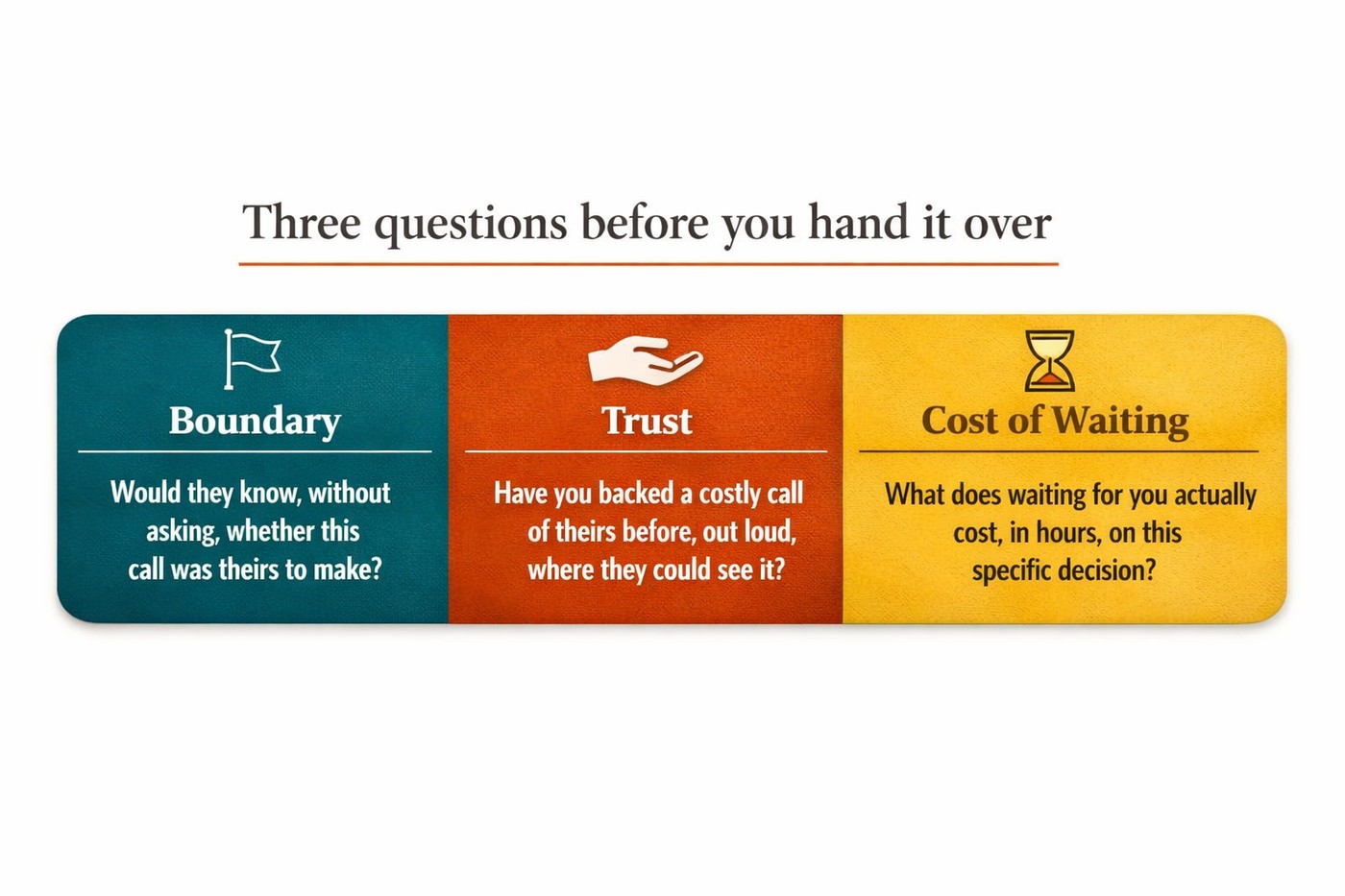
Where does their authority actually start and stop? Not in a job description. In practice, would they know, without asking, whether this specific call was theirs to make? If the honest answer is "probably not," that's not a trust problem, it's a boundary that was never drawn.
Have you backed a costly call before, out loud, where they could see it? Trust that isn't demonstrated doesn't transfer. If the only calls you've backed so far were free ones, nobody in your business actually knows what you'll stand behind when it costs you something.
What does waiting for you actually cost, in this specific decision? Not in general. In hours, in a live campaign, in a customer relationship. If nobody's ever worked that out, there's no pressure pushing the decision down to where it should sit, so naturally it drifts up instead.
None of these require a project. They require picking one decision that currently queues to you, and deliberately answering all three before the next version of it happens.
This is also why corporates struggle here so visibly, even with good people and good intentions. They've usually built layers of approval specifically to prevent moments like this one, because somewhere in the company's history, someone made a fast call that went badly, and the response was to add a checkpoint. Then another bad call, another checkpoint. Eventually every decision has so many checkpoints that nobody owns anything, and the business wonders, sincerely, why it can't move like it used to.
Founder-led businesses going through their own scale-up moment have the opposite problem and somehow end up in the same place. They resist adding any structure at all, convinced that structure is what kills the thing that made them fast. So decisions stay informal long past the point where informal still works, and the same handful of people end up making every call because nobody else was ever given the boundary, the trust or the stakes to make it themselves.
Both businesses lose the same thing in the end. They just walk toward it from opposite directions.
If you want to know whether ownership actually exists in your business, or just looks like it does from the leadership table, there's a simple enough test. Find a decision two levels down from you that mattered, and ask who made it. If the honest answer is "it came up to me eventually," you don't have an owner's mindset in your business yet. You have a queue.
I'll come back to this in the next piece, because once you've built the structure that protects ownership rather than replacing it, something else starts to happen across the whole business, not just in the one team where you fixed it. That's the part of the Compound Effect I find genuinely interesting, and it's where this series is heading next.