Three articles ago, I started with a paradox. Founder-led businesses reject the structure that would let them scale, because structure feels like the enemy of the speed that built them. Corporates chase back the speed they've lost, while keeping every layer that was built specifically to prevent it. Both are solving the same problem from opposite ends, and both, more often than not, end up stuck in the same place.
Then I looked at why founder-led rooms talk openly about failure while corporate rooms only show the highlights. The research was clear on this: the teams that report more mistakes aren't worse teams. They're the ones safe enough to catch problems while they're still small.
Both are solving the same problem from opposite ends, and both end up stuck in the same place.
Then a story about a DTC manager who closed down a viral offer without waiting for me, because the cost of waiting was higher than the cost of acting alone. What made that possible wasn't his personality. It was three specific things, a boundary, a track record of trust, a clear cost to hesitating, all of them built before the crisis ever happened.
Three different angles. One underlying question. How does a business hold on to what made it work in the first place, while building what it needs to keep working at a size nobody personally designed for?
That question is what we built Compound Leadership Group to answer. Not as a slogan. As a methodology.
Today's business is the outcome of yesterday's decisions
Businesses rarely fail because of one catastrophic mistake. They succeed, or they struggle, because of thousands of decisions made over time, each one influencing the next.
Most businesses are run as if the opposite were true. Leadership teams look for the big strategic call that will fix things, the new market, the new hire, the new system, when the actual lever is almost always smaller and closer to hand. A decision about who owns what. A habit about how mistakes get discussed. A boundary about who can say yes without asking first.
Get a handful of those right, consistently, and they don't just improve the area you touched. They reinforce each other. That's the Compound Effect, and it's why we built our methodology around five stages that work as a cycle, not a straight line.
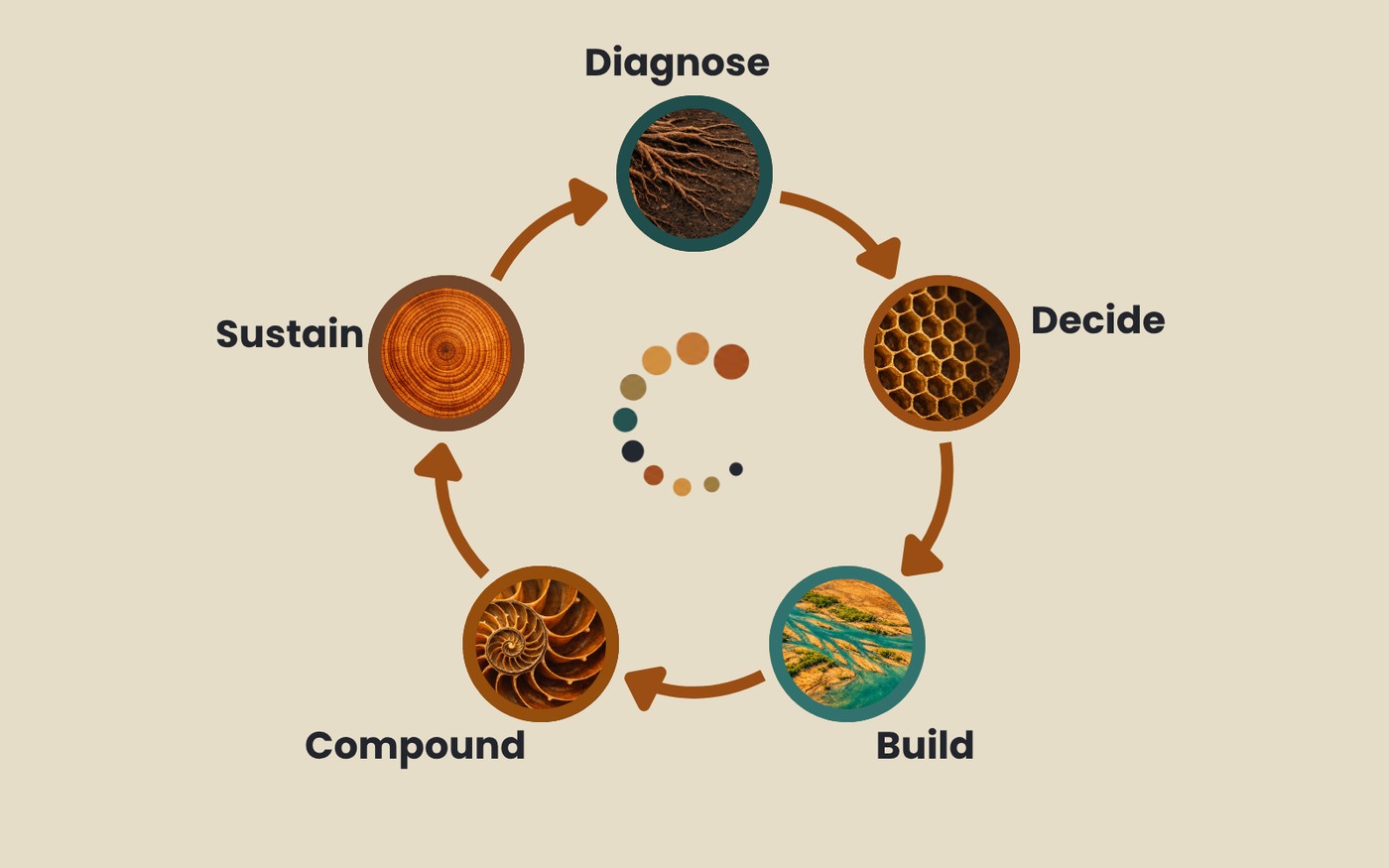
Diagnose
You can't fix what you haven't properly named. Most businesses know something feels harder than it should, but they misdiagnose where the friction sits. They blame the market, or the team, or a system that needs replacing.
Look back at the offer that went viral. The real issue wasn't the promotion mechanics, that was just where the crack showed. The real issue was that nobody had ever properly decided who could act, and how fast, when something like this happened. Diagnosis means treating leadership, commercial performance, operations and organisational capability as one connected system, because they already are one, whether anyone designed them that way or not.
Decide
Not every issue deserves equal attention. Trying to fix everything at once is how good intentions turn into a dozen initiatives that all stall together.
This stage is about clarity. Which two or three decisions, made properly, would change the shape of everything downstream? Often it comes down to where authority sits, or whether the business has actually decided what happens to someone who admits a costly mistake. Get that second one wrong and it doesn't matter how well you design the first. Nobody will use the authority you've given them if they're not sure it's safe to.
Build
This is where trust becomes something real rather than something stated. The DTC manager could act without me because three things had already been built, deliberately. He knew where his authority started and stopped. He'd seen me back a costly call before, so he knew backing was real rather than theoretical. And he knew what waiting would cost, in hours, on a live campaign, which gave him a reason to act rather than escalate.
Take away any one of those three and the story doesn't happen. Ideas become habits. Habits become systems. Systems are what make a good decision repeatable instead of a one-off, which is what this stage is actually for.
Compound
Most businesses never quite reach this stage, because it asks for something counterintuitive. You have to trust that improving one part of the system strengthens parts you didn't directly touch.
Here's what that looked like in practice. The DTC manager's willingness to act didn't come from nowhere. It came from a business where telling me about a costly mistake, after the fact, had never once gone badly for anyone. That's psychological safety showing up as speed. The honesty that article two was about, and the ownership that article three was about, were never two separate things. One makes the other possible. Better decision rights improve execution speed. Honest, fast execution catches problems while they're still small and cheap rather than large and expensive. That's not a coincidence. It's the whole mechanism.
Sustain
The future belongs to businesses that keep asking who leads next, what capability needs building before it's urgently needed, and which changes are actually worth adopting rather than just fashionable to mention.
This is also where the conversation about structure and speed comes full circle. A business that has built ownership properly into its decision making doesn't need to choose between staying entrepreneurial and growing up. It's already done both, because it never treated them as opposites in the first place.
Why we built it this way
We're not traditional consultants, and we didn't want to write a series that read like one. We've sat in the seats we're talking about. We've made the call the DTC manager made, and we've also been the layer of approval that quietly slowed someone else down without meaning to.
Small improvements, repeated consistently, create exponential impact. Not because any single improvement is dramatic, but because they reinforce each other until the business starts compounding without needing to be pushed.
That's what we help ambitious businesses build. Not a bigger version of what they already have. A stronger one, designed properly, that gets better at getting better, year after year.
If any part of this series landed because you recognised it, the conversation is open.