
Go to a founder dinner and listen for more than ten minutes. Someone will tell a story about the time they nearly ran out of cash, the warehouse that flooded, the hire that should never have happened, the year they got the pricing completely wrong. People lean in. They laugh. They ask follow-up questions, because the failure is usually more useful than the win.
Now sit in a corporate town hall. Watch how carefully every story is curated before it reaches the stage. The wins get airtime. The losses, if they appear at all, arrive pre-packaged as "lessons learned" with the rough edges sanded off.
I have sat in both rooms more times than I can count. The difference comes down to something more specific: whether a business has actually built the conditions for people to tell the truth.
The research behind the instinct
This is not just a nice observation. It has a name, psychological safety, and it has been tested rigorously for over twenty-five years.
Amy Edmondson, the Harvard professor who coined the term, ran a study in the 1990s expecting to confirm something intuitive: that better-performing hospital teams would make fewer medication errors. The data said the opposite. The higher-performing teams reported more errors, not fewer.
That single, counterintuitive result is the whole story in miniature. The better teams were not making more mistakes. They had enough psychological safety to talk about the ones they made, which meant those mistakes got caught, corrected and learned from, rather than buried until they became something worse.
Google reached the same conclusion independently. Their internal Project Aristotle studied 180 teams trying to work out what separated its highest-performing teams from everyone else. They tested for shared hobbies, personality mixes, management styles. None of it predicted performance. The strongest predictor, by a clear margin, was psychological safety: whether people felt safe enough to take a risk, admit an error or challenge an idea in front of their colleagues.
The absence of visible problems is not evidence of health. A team or a business that never surfaces an error is not necessarily doing well. More often, it has simply trained its people to stop reporting.
The absence of visible problems is not evidence of health.
Why founder-led businesses tell the truth about failure
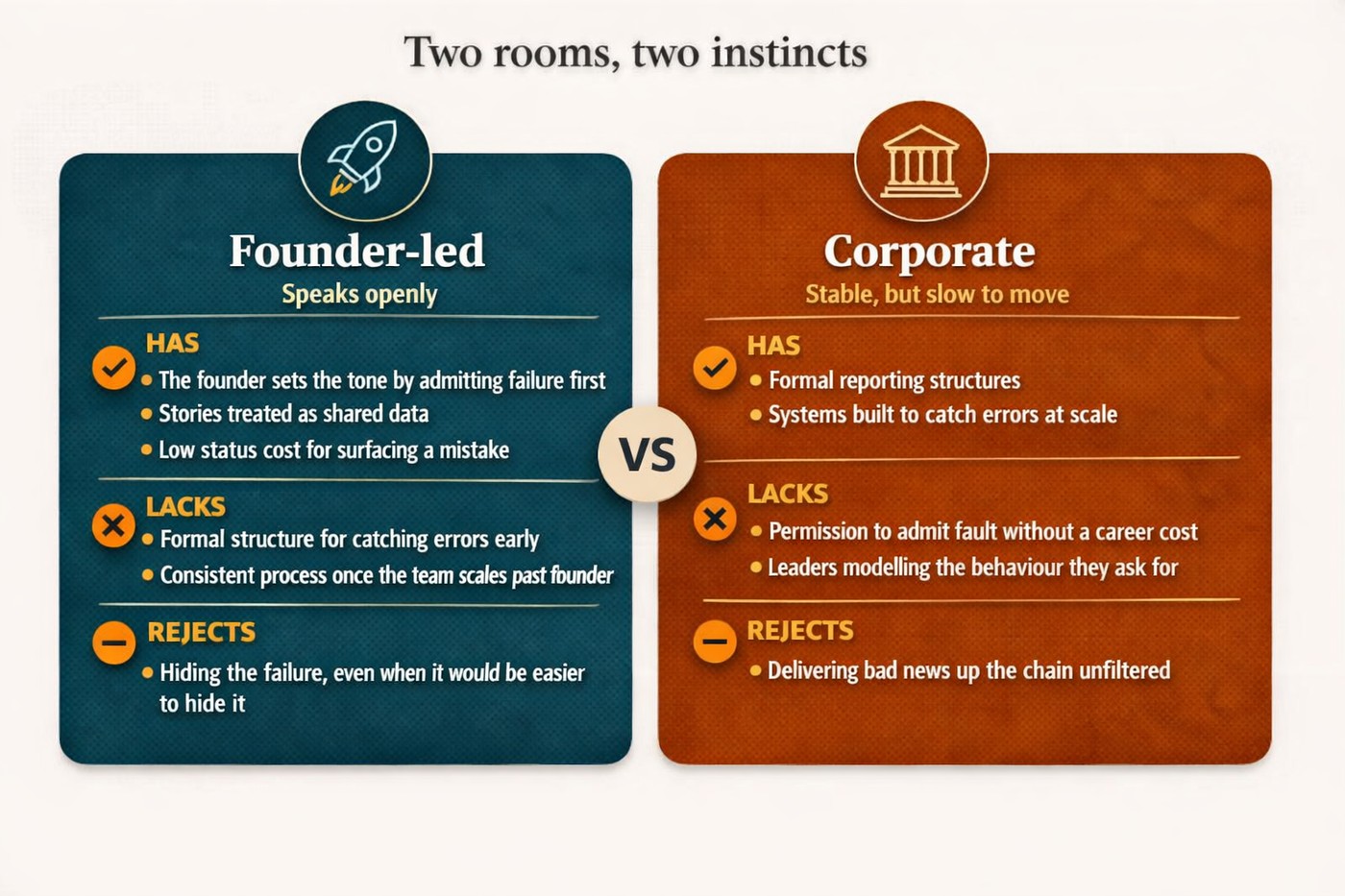
Founder-led businesses earn this honesty for a simple reason: the founder usually lived the failure themselves, in public, with their own money on the line.
When the person at the top openly admits they nearly ran out of cash or backed the wrong hire, it gives everyone else permission to do the same. There is no performance to maintain, because the person with the most status in the room has already shown that mistakes are survivable and, often, the most interesting part of the story.
This is also why those stories travel so well at founder events. The room has decided, collectively, that failure is data, and stories like these are how that data gets shared.
Why corporates train people to hide it
Corporate culture rarely sets out to punish honesty. It happens gradually, through entirely reasonable-seeming mechanisms.
Performance reviews reward the story that makes someone look good. Promotion cycles favour the clean track record over the honest one. Layers of management mean that by the time a problem reaches the top, three or four people have already quietly softened it, because nobody wants to be the one who delivered bad news up the chain. None of this is malicious, it's simply what happens once a business adds enough layers and enough stakes to every conversation.
The cost shows up later, and it shows up expensively. A team that has learned to hide its mistakes only looks calm and well-run. Underneath, problems are quietly compounding, unreported, until something breaks loudly enough that it can no longer be managed quietly.
The leading indicator hiding in plain sight
If you want an early read on whether a business is still genuinely learning or has started to coast, do not look at the strategy deck. Listen to how people in the room talk about what went wrong last quarter. A business still compounding tells that story plainly, including its own part in it. A business starting to protect itself from its own truth lets the conversation drift toward context, extenuating circumstances and other people's decisions, usually the first sign that the compounding has quietly stopped.
This is not an argument for chaos or for celebrating failure as an end in itself. Edmondson is precise on this point. Psychological safety is not comfort, and it is not the absence of high standards. The best teams she studied disagreed openly and held each other to demanding expectations. What safety buys you is not an easier ride. It is faster, more honest information about what is actually happening inside your business, which is the raw material every good decision depends on. That honest information is what lets small improvements compound instead of stall.
In the next article in this series, I want to look at what that owner's mindset actually looks like once you strip away the personality and the war stories, because ownership is something you can design for deliberately, structure for properly and lose without ever noticing, right up until you need it most.