

I have sat on both sides of this problem.
I have worked inside large corporates with the budgets, the brand and the systems to do almost anything, and watched good ideas die in committee because nobody owned the decision. And I have worked inside founder-led businesses with none of that infrastructure, where decisions happened in minutes, until the business outgrew the founder's ability to make them all personally, and everything started to wobble.
Most recently, as Managing Director of a founder-led business moving through its scale-up phase, and before that advising founder-led clients directly, I have watched the same pattern play out from both seats: the very thing that made the business work stops working, at almost exactly the moment the business needs it most.
There is a name for this. Bain & Company call it the Founder's Mentality, and their research is worth sitting with, because it puts hard numbers behind something most operators only feel.
The number that should worry every growing business
Bain's research found that only around 7% of companies become what they call "scale insurgents", businesses that grow to real scale while keeping the speed, focus and ownership mentality that got them there in the first place.
That 7% punches well above its weight. According to Bain, these companies account for more than half of all the net value created in public markets each year.
The other 93% don't fail outright. Most of them grow, hit a wall, and then quietly stop compounding. Bain attributes roughly 80% of the big swings in company value, up and down, to decisions made during three predictable moments in a company's growth: overload, stall-out, and free fall. The first of those, overload, is the one founder-led businesses hit first and recognise least.
McKinsey's research tells a similar story from a different angle: of companies that have already found genuine product-market fit, the hard part, supposedly, 78% still fail to scale successfully. Not because the product was wrong. Because the organisation underneath it wasn't built to carry the weight.
Most of them grow, hit a wall, and then quietly stop compounding.
Why founders fight the very thing they need
Here's the paradox I keep seeing close up. The founders who built something real, who took the risk, made the calls, and earned the right to trust their own judgement, often resist the next stage almost on principle.
Process gets read as bureaucracy. A second layer of management gets read as losing touch. Documenting how something is done gets read as killing the spirit that built it. I understand the instinct completely; I have felt it myself. When you have spent years moving fast because you decided everything yourself, structure looks like the enemy of speed.
But it isn't speed that structure threatens. It's control, and those are not the same thing.
A business with twelve people doesn't need a decision-rights framework. The founder is the framework. A business with a hundred and twenty people absolutely does, because the founder physically cannot be in every conversation anymore, and without something to replace their judgement, decisions either stall waiting for them or get made inconsistently without them. Bain's research calls this the loss of an "owner's mindset" as companies scale, and it's striking how often that loss isn't really about people caring less. It's about nobody having designed how ownership should work once one person can no longer hold it all.
Why corporates fight the opposite thing
The mirror image of this is just as common, and just as costly.
Established corporates know exactly what they're missing. They send leaders on innovation programmes, build "agile" pods, run hackathons, and talk endlessly about wanting to move like a start-up again. I have sat in those rooms. The intent is usually genuine.
What gets rejected, almost always, is the actual mechanism that produces start-up speed: a single person empowered to decide something quickly, without three committees and a RACI chart first. Corporates want the output of an owner's mindset, speed, accountability, proximity to the customer, while keeping every structure that was specifically built to prevent any one person from deciding too much, too fast. You cannot have both. The structures that protect a large, complex organisation from individual error are frequently the same structures that strangle the instinct to just decide.
The result, in both directions, is the same underlying mistake: treating structure and ownership as opposites, when they are actually meant to work together.
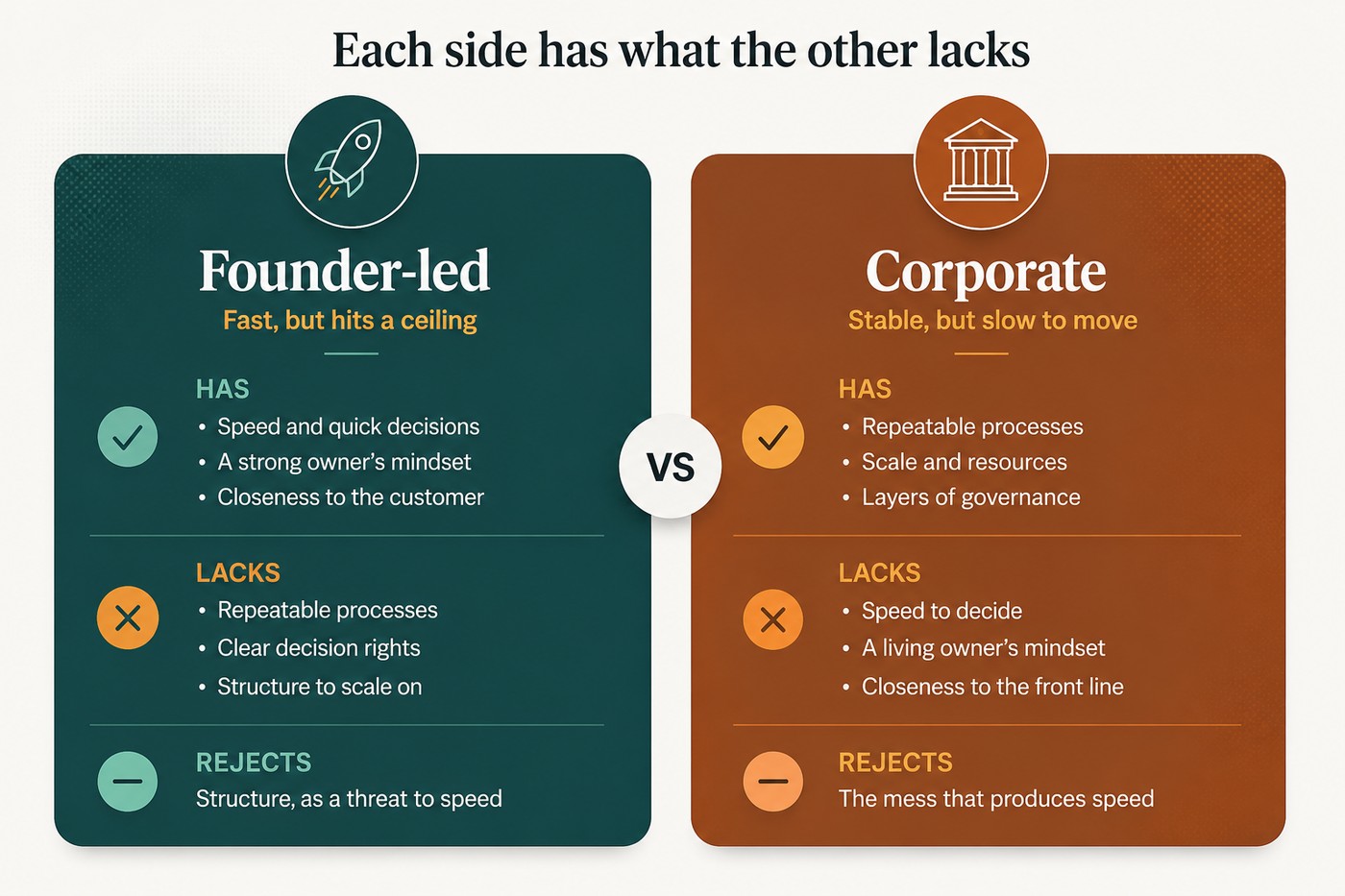
Structure and agility were never enemies
The businesses in that 7% Bain identified didn't choose between discipline and ownership. They built structure that was designed to protect ownership, not replace it, clear decision rights, yes, but pushed down close to the customer and the front line rather than pulled upward into committees. Process that made good judgement repeatable, rather than process that substituted for judgement entirely.
That's a deliberate design choice, not an accident of culture, and not something you either have or don't. It's something you build, the same way you'd build any other capability in the business.
This is the heart of what we mean by the Compound Effect. Small, well-designed improvements to how decisions get made, who owns what, and how the business learns from its mistakes don't just fix one department. They reinforce every other part of the system, and that reinforcement is what separates a business that grows from one that compounds. It's the thinking behind our whole approach, and the businesses it's built for are the ones we work with.
In the next article in this series, I want to look at something I have noticed sitting in rooms on both sides of this divide: founder-led businesses love getting together to talk openly about everything that went wrong. Corporates, almost without exception, only want to show you what went right. That difference is not just cultural colour, it is one of the clearest leading indicators of which of these two kinds of business is actually still learning.